
Computerama
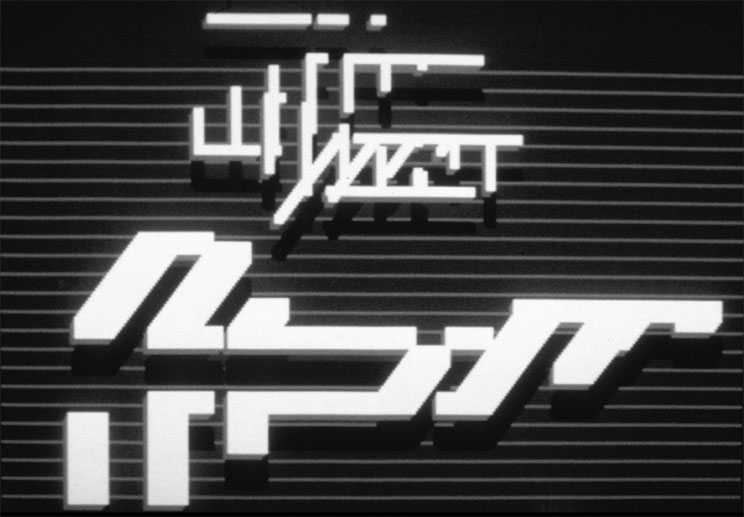
With improvements in computers (and improved access to them), several artists have made imaginative new films. Michael Scroggins, who had worked in video graphics with fluid color ambiances, created the rigorous 1921>1989, in which solid geometric forms in primary colors float around and through each other, reflecting in their polished surfaces. Suggestive of the Neo-Plasticism of Piet Mondrian and Theo van Doesburg, the film is accompanied by a fine musical choreography.
Vibeke Sørensen used the mapping potential of her computer to wrap complex animations around other forms, including cubes, polygons and the open-centered torus. Sørensen composed her animated designs to work well with spatial warping, and their rich variety of color and shape dazzles all the more when multiplied five, ten and one hundred times. Sørensen’s 1993 Maya has been called “stereo drawing in Cyberspace,” since its three-dimensional images can be perceived in depth either by crossing one’s eyes or by using special glasses. Around 1950, Dwinell Grant, Oskar Fischinger, Hy Hirsh, Harry Smith and Norman McLaren all made 3-D films, but their hand-made animations were relatively simple compared to the dazzling array of Maya, in which it seems that a hundred different ribbons, circles, triangles and polygons are moving at the same time.
The German artist Jules Bister found a different solution to dimensional illusion in the new Softimage program. His exquisite Endogenesis shows shapes moving, bending and undergoing subtle metamorphoses in a continuous dynamic flow which delights and astonishes. Robert Darroll conferred with Bister on commercial projects from time to time, and sought his technical advice while composing his film Memb, which also used Softimage. The program allowed him to let a surface covered with abstract imagery breathe, burst and fly apart.
Darroll’s latest film Moe’s Field, recorded at the Centre for Media and Technology in Karlsruhe, Germany, uses computers to combine complex layers of modified live-action footage with drawn animation and text — somewhat in the tradition of Hy Hirsh and Pat O’Neill, but with a meditative dynamism all Darroll’s own.
Moritz, William. “History of Experimental Animation.” Website. Absolut Panushka, curated by Christine Panushka. (Jan-Apr 1997).